- Payment Options
- Terms Conditions
- Malibu 453 blv
- info@charity.com





January 20th, 2026
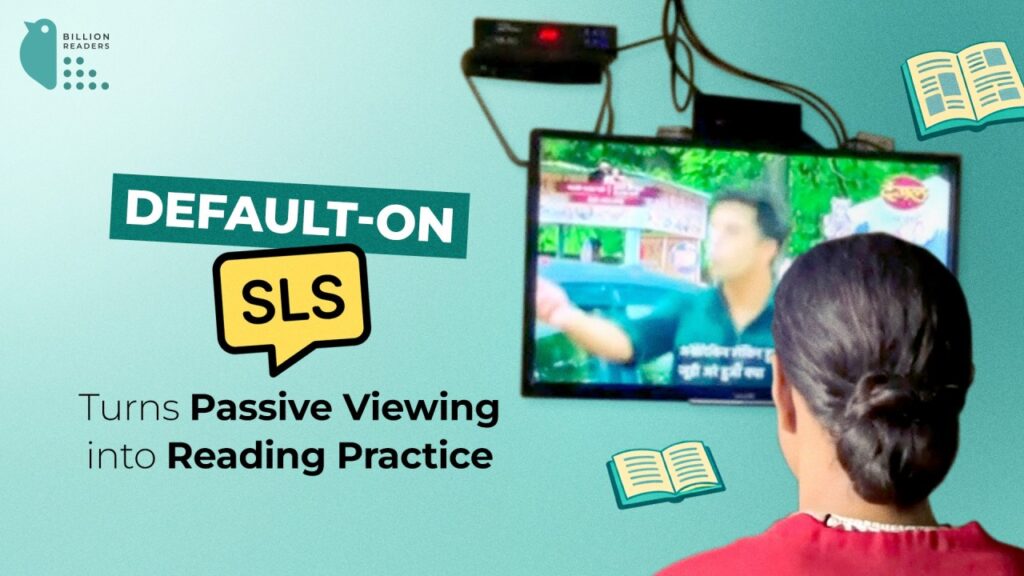
TV serials have a unique opportunity not only to provide entertainment but also serve as safe places for consistent reading practice, especially for weak readers. TV serials typically have slow-moving parallel plotlines, with a clear beginning, middle and end for each episode, as the story arc continues in the following episode. Currently, passive viewing is common in rural households, with women doing household chores, and other work, as the plot slowly develops in the episode. A small technical shift of adding highly legible same language subtitles (SLS) to all episodes, creates a low-stakes learning environment. As the viewer already understands the narrative context, even during passive viewing, they keep getting exposed to printed text on screen, and automatically decode it, encouraging incidental reading practice amid daily chores.
Between September and November 2025, we conducted a survey with 1100+ rural women in the Hindi speaking belt.The survey focused on understanding their reading abilities, subtitles awareness, and media consumption habits. The data was telling: Firstly, more than 300 participants (~30%) reported struggling with reading. Secondly, participants showed a limited understanding of same language subtitles as a concept, often viewing them as a technical feature (such as news tickers, disclaimers, or credit rolls). Some were familiar that subtitles are shown for accessibility when media content is in a language other than Hindi. Lastly, most of these women consume TV content daily for entertainment, with popular drama-based serials from Dangal TV, Star Utsav, Zee Anmol, and Sony.
These three points put together, make the case for “default-on” subtitles. If SLS is enabled by default, it offers immense opportunities for involuntary and incidental reading practice among weak readers — adding thousands of words of printed text to their daily routines. Viewers begin to process the text before they even realize it. While fluent readers can easily turn off the subtitles if they find them distracting, the default-on setting ensures that the weak readers are immersed in text, leading to their reading fluency and proficiency actually improving through habit.
Default-on SLS on each episode on the above channels could provide weak readers with access to thousands of words of print text every single week in the privacy of their own homes. This private environment is essential because it removes the social stigma and fear of failure often associated with adult literacy classes. While attentive TV watching allows the viewers to practice reading while listening to the audio, passive TV watching enables incidental and automatic reading of the printed text. Thereby, default-on SLS prevents a loss of reading proficiency through consistent, regular reinforcement.
This impact of subtitles extends beyond the shared TV set in households. Our survey revealed that 80% of the participants between 16 to 40 years of age regularly consumed media content on YouTube or other online sources on their mobile phones. This trend is blurring the lines between watching TV in the form of scheduled telecasts and consuming episodes on OTT apps. Default-On SLS on online sources and telecasted content could lead to universal immersion for the regular TV watching audience. When a user switches from a television broadcast to a YouTube clip, the presence of identical same language subtitles could ensure that their reading practice remains consistent and regular, effectively turning their smartphone into a regular reading companion.
The bottom line is that if high quality Same Language Subtitles become commonplace on TV content, the access to print text can increase manifold, especially in weak reading communities, without disturbing their daily TV routines. This simple technical shift could lead to adult weak readers retaining their language proficiency whileactively strengthening their abilities through the very programs they already love to watch.
Tanushree Rawat – Senior Research Manager
Tanushree is a Researcher and Project Manager committed to equity in education, with 8+ years of experience in the US, Asian and African education contexts. She is an expert in research design and execution, program design, stakeholder management, and leading trainings and workshops.





Leave a Reply