- Payment Options
- Terms Conditions
- Malibu 453 blv
- info@charity.com




May 22nd, 2026
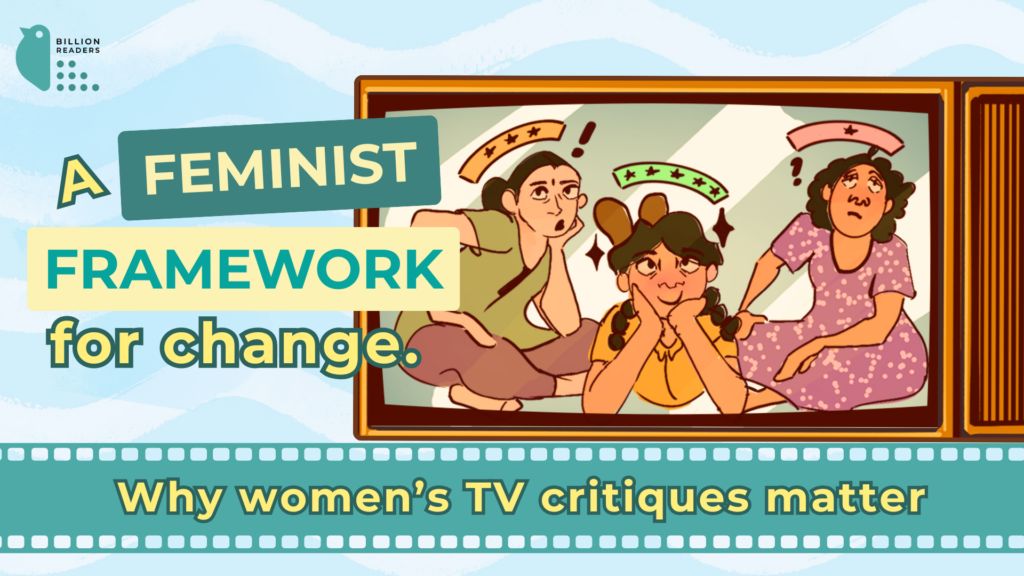
Three women from a minority community in Delhi, who watch a lot of Hindi serials were asked a simple question: What do they think about the content they consume?
Television that was made for them, marketed at them, beamed into their homes every single day.
Rarely ever asked them what they thought about it.
That changed in December 2025, when BIRD’s Research and Gender Team piloted the Feminist Framework for Media at the Delhi Centre, a structured tool designed to evaluate gender representation in visual content. The three women were asked to watch episodes of popular Dangal serials and rate them across parameters like stereotypes, violence, and power play.
What the pilot uncovered wasn’t just data about problematic TV content. It uncovered something far more significant: what happens when ordinary women are handed a framework and asked to think and express.
The first week was hard, but not in the way the researcher expected.
The candidates could see the problems on screen clearly. They noticed when a female character was humiliated. They felt discomfort when a storyline reinforced that a woman’s worth was tied to her cooking. They recognised, even if wordlessly, the thousand small cruelties that serial narratives serve up as drama.
The struggle wasn’t in the seeing. It was in the saying.
Turning an observation into a sentence, ‘a complete, written, reasoned sentence’ was lost territory. Two of the three candidates had had no active reading or writing practice since leaving school, except occasionally reading their children’s textbooks. The idea that their opinion was worth writing down, worth recording, worth preserving in a form was new.
There was a bit of hand holding and prompting them with questions like. What did you watch? How did it make you feel? What bothered you about that scene? Slowly, thoughts became fragments. Fragments became sentences. Sentences became justifications.
By the second week, something had shifted.
By the final two weeks, all three candidates were independently watching, rating, and submitting their evaluations on time, without prompting, without hand-holding. Two of them had developed their own system: write the thought down first, then use speech-to-text to type it into the form. They had found their workaround. They had found their way to express their opinion on the media they consume.
In the final Focus Group Discussion, when asked what they valued most about the experience, the candidates didn’t talk about the serials. They talked about this – the ability to take what was in their head and make it legible to the world. They called it the most positive part of the whole exercise.
There was a second thing the candidates said in that final discussion:
“There is always something asked about men,” one of them said. “But rarely anything that asks about women or speaks directly to them.”
It sounds simple. But it isn’t.
These women live in a media landscape saturated with stories about women but rarely ones that treat women as analysts, as critics, as people with valid interpretive authority over the content made in their name. Conversations about women’s representation tend to happen in conferences, in academic journals, in NGO reports. They rarely reach the women actually sitting in front of the screen.
Being asked, genuinely asked: what they thought about the serials they watched felt, in their own words, meaningful. Not as a token gesture, but as a real invitation to be heard.
And when their evaluations were compared with those of the researcher who independently rated the same episodes, something interesting emerged: their readings were broadly aligned. The language differed: the candidates wrote in Hindi, in everyday idiom, in the vocabulary of lived experience rather than feminist theory, but the underlying interpretation was often the same. They were applying a critical lens. They just hadn’t been given a name for it before.
The pilot was designed to test a tool. What it revealed was an insight.
Women who consume FTA (Free-To-Air) television are not passive recipients of whatever narrative is handed to them. They negotiate, resist, and reinterpret. They notice things. They have opinions. They have, in many cases, already developed an instinctive feminist analysis. They simply haven’t had access to a space that validates it, structures it, or takes it seriously.
The Feminist Framework for Media became that space for them.
It gave women a scaffold, not to tell them what to think, but to help them say what they already thought. It asked for justifications, which meant it asked them to trust their own reasoning. It rated their responses as data, which meant it treated their perceptions as evidence. And in doing so, it quietly communicated something that the serials and the entertainment industry rarely do: your perspective matters.
The pilot is a beginning, not a conclusion. The tool needs continuous refinement. The candidates themselves surfaced these gaps, which is itself a mark of their engagement.
But the larger question the pilot raises is one that goes beyond any single tool: If three women from Delhi, with varying education levels and no formal training in media studies, can produce nuanced, reliable, critically grounded evaluations of popular TV content. What does that say about all the women watching television right now, whose opinions have never been solicited?
It says we’ve been asking the wrong question all along.
The question isn’t whether these women are capable of critical media engagement. They always were.
The question is why did it take so long (to understand) for their voices to matter?
This blog is based on the pilot findings of the Feminist Framework for Media, conducted by BIRD’s Research and Gender Team at PlanetRead’s Delhi Centre, December 2025 – January 2026.
READ IT ON LINKEDIN
This blog is based on the pilot findings of the Feminist Framework for Media, conducted by BIRD’s Research and Gender Team at PlanetRead’s Delhi Centre, December 2025 – January 2026.
Saba – Project Coordinator (Delhi)
Saba Shah is a Delhi-based Project Coordinator with BIRD (Billion Readers), where she works with the Research and Gender Team. She holds a Master’s degree in History from the University of Delhi and has previously worked in archival research and digitization. Her interests include media, gender, history, and the role of culture in shaping social narratives.




Leave a Reply