- Payment Options
- Terms Conditions
- Malibu 453 blv
- info@charity.com






March 18th, 2026
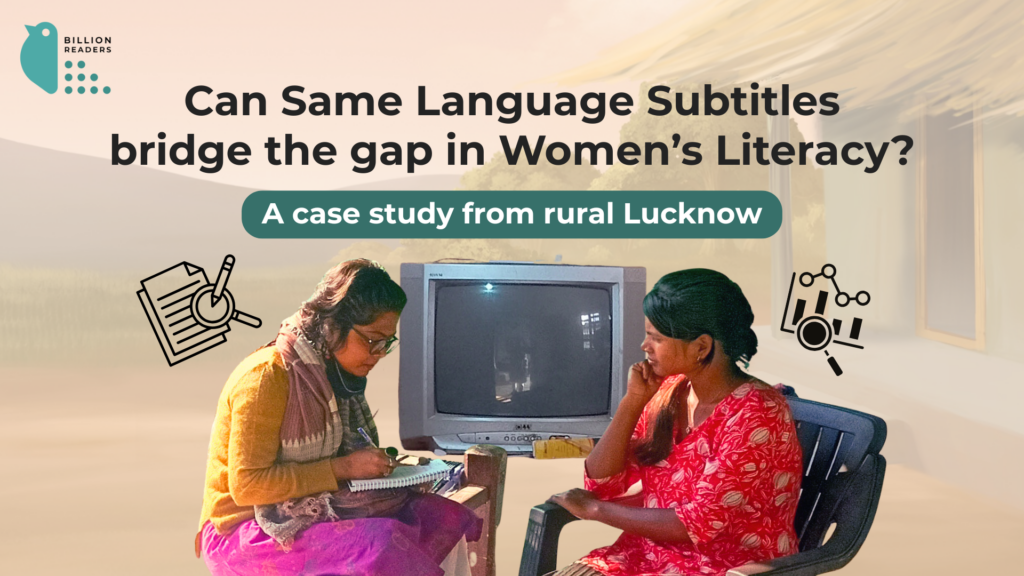
In the evolving media landscape of rural North India, television is far more than a source of entertainment; it has become a significant cultural and pedagogic space. Drawing on ethnographic fieldwork across 11 villages in rural Lucknow, this study examines a critical question: can Same Language Subtitling (SLS) meaningfully support literacy among rural girls and women? While SLS is a low-cost literacy intervention, its effectiveness is deeply gendered and economically stratified in rural contexts. The discussion below unpacks these complexities and their implications for literacy access.
Rural Lucknow presents a layered socio-economic reality marked by agrarian livelihoods, uneven media access, and persistent gender gaps in education. The government data shows that female literacy (58.29%) in the district continues to lag behind male literacy (76.42%) by a substantial margin (approximately 18-percentage-point gap), reflecting long-standing structural inequalities in educational access and retention [Office of the Registrar General & Census Commissioner, India (2011)]. This study, therefore, explores how subtitles operate within women’s lived media ecologies.
The fieldwork engaged 104 women, adolescent girls, and children across multiple households and included a focused group discussion with 55 school children (both boys and girls). The sample represented diverse caste, class, and religious backgrounds across eleven villages. Using in-depth interviews, participant observation, and short reading assessments, including exposure to Star Dost Hindi story videos (https://billionreaders.org/stardost/), the research documented how subtitles intersect with routine television and mobile viewing habits. The findings suggest that while SLS has considerable potential, its mere presence may not be sufficient to ensure meaningful reading engagement, as engagement and uptake in everyday life is shaped and often mediated by social context, viewing practices, household relations, and the material conditions of media access.
Economic inequality emerged as one of the strongest predictors of SLS exposure. Television ownership and functionality were unevenly distributed across households, with poorer families more likely to report the absence of a television set, the presence of a non-functional set, or reliance solely on basic mobile phones. Marginalised caste and minority community households were particularly disadvantaged in this regard. As a result, the potential reach of subtitle-based interventions remains structurally constrained.
Across villages, awareness of SLS remained strikingly low. Many women reported that they had never consciously noticed subtitles while watching television. Among those who had seen them, most indicated that they relied primarily on listening to dialogue, turning to subtitles only when the audio was unclear or missed. Among schoolchildren as well, active subtitle reading was limited. Several children reported that the text moved too quickly to follow comfortably, while others felt that reading was unnecessary because the spoken Hindi already conveyed the meaning. These patterns suggest that the passive availability of SLS may not necessarily, by itself, lead to sustained reading practice, as engagement with subtitles is often influenced by everyday media practices and the conditions under which television is accessed.
Engagement with SLS varied sharply by education level and age. A small number of more educated respondents demonstrated active and even critical engagement; for instance, one graduate woman reported carefully reading subtitles and noticing errors. Several adolescent girls described incidental reading, explaining that they glanced at subtitles only when their eyes happened to fall on the text (“nazar chala jata hain to dekh liye”). Others reported deliberately switching subtitles off while watching educational content on YouTube because divided attention made comprehension more difficult (“hata dete hain, kyunki dhyan do jagah pe chala jata hain”). These variations indicate that subtitle use exists along a spectrum rather than as a uniform behaviour.
Importantly, women’s reading practices cannot be separated from the gendered organisation of everyday life. Early marriage, mobility restrictions, heavy domestic workloads, and chronic time poverty continue to shape women’s opportunities for literacy engagement. Many married women expressed limited optimism about pursuing reading improvement at later stages of life, even in households where overt restrictions were relatively minimal. The burden of unpaid care work remains a major structural barrier to sustained literacy practice.
At the same time, the study surfaced an important zone of possibility. SLS appeared to show its strongest potential among semi-literate users, particularly school-going children and younger women with some educational foundation (a class 7 student expressed that subtitles could improve reading ability- “Speed achha ho jayega… Hindi sahi ho jayega. If one reads SLS then they will understand better than listening only”; another young respondent explained how subtitles help understand difficult words- “Some difficult words can be understood after reading through SLS; one can learn spellings through it”; and a young literate woman explained that subtitles are read “to improve reading”, and to anticipate the upcoming dialogue). For older low-literate women, however, subtitles alone were insufficient to produce meaningful literacy gains. Taken together, the findings suggest that SLS functions as a complementary literacy support, reinforcing existing reading abilities among viewers with some educational foundation. This observation aligns with earlier research on SLS, particularly the work of Brij Kothari and colleagues, which conceptualises SLS as a mechanism for integrating regular reading practice into everyday television viewing rather than as a standalone literacy intervention (Kothari, Pandey, & Chudgar, 2004). This study contributes to this body of scholarship by examining how these dynamics operate within rural communities around Lucknow, demonstrating that the potential of SLS to support reading practices is closely shaped by everyday social conditions, such as gendered norms governing television access, disparities in educational exposure, and the uneven presence of television within households, which influence who is able to engage with and benefit from the subtitles.
One of the study’s most revealing insights concerns how rural women themselves conceptualise rights and empowerment. Rather than invoking abstract legal frameworks, respondents articulated women’s rights through everyday freedoms, the ability to study, to move outside the home, to choose what to eat or wear (which, for many of us, are not even perceived as “rights” but taken-for-granted privileges), and to pursue work. In several conversations, these ideas surfaced in relation to media exposure- for instance, some women referred to television programmes where female characters were shown studying, working in positions of responsibility and leadership, decision making, or speaking assertively within the household, which they contrasted with the restrictions they experience in their own lives. At the same time, among some literate or semi-literate women and school-going adolescent girls, media exposure often became a point of reflection for articulating their own aspirations. In several conversations, these respondents spoke about wanting to continue their education, “become something” in life, and achieve a degree of economic independence. They further expressed an emerging awareness of women’s rights and entitlements, a growing sensitivity to gender inequality, and a critical understanding of the discrimination and oppression faced by women and other marginalised groups. Within these reflections, they also described the everyday ways in which they attempt to navigate and negotiate patriarchal expectations in their families and communities. Such interactions suggest that media consumption, while not transformative on its own, can contribute to small shifts in awareness and aspiration by making alternative possibilities visible within everyday domestic spaces. This grounded vocabulary, therefore, underscores the intimate, though often subtle, relationship between literacy exposure, media consumption, and evolving gender consciousness in rural settings.
The rural Lucknow experience ultimately offers a sobering but constructive lesson- SLS is promising but not self-executing; it cannot produce change on its own. Its success depends on surrounding social conditions, such as access to TV, viewing time, gender norms, encouragement to read, and freedom for women and girls to engage with media. Its effectiveness is currently mediated by uneven media infrastructure, low levels of conscious attention, gendered time poverty, and discontinuities in girls’ education. SLS should therefore be understood as a complementary pedagogic layer whose effectiveness depends on its integration within supportive social and educational ecosystems.
To unlock the full potential of subtitle-based learning, policy attention must move toward encouraging intentional reading habits, improving subtitle pacing and accuracy, integrating SLS exposure within school and community learning spaces, addressing gendered constraints on women’s time, progressive media content, and expanding functional media access among low-income households. Without such ecosystem strengthening, the transformative promise of SLS will remain only partially realised.
The story from rural Lucknow is therefore neither one of failure nor of uncomplicated success. Rather, it reveals a technology encountering the dense realities of gender, class, and everyday life. Where supportive conditions exist, especially among younger semi-literate viewers, the sparks of impact are clearly visible. With sustained institutional support and gender-sensitive implementation, SLS holds the potential to become a quiet but meaningful contributor to advancing women’s literacy in rural India.
For the full report, readers can access the link provided.
About the Author
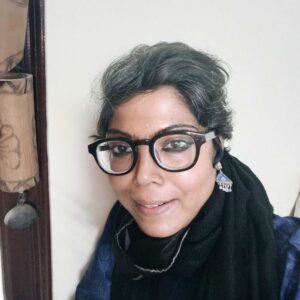 Dr. Maitree Devi –
Dr. Maitree Devi (she/her) is a feminist researcher, political scientist, and academic whose work focuses on gender, law, social justice, and the rights of marginalised communities in South Asia. Her research examines the intersections of gender, personal laws, legal pluralism, citizenship, identity, and political reform, with particular attention to the experiences of minority women and other socially excluded groups. She is especially interested in understanding how civil and personal laws, power relations, and structures of inequality shape women’s rights, agency, and access to justice within diverse social and political contexts. Her scholarship spans a wide range of themes, including women’s movements in India and Bangladesh, minority women’s rights, property rights, constitutional and personal laws, violence against women, gender relations in higher education and student politics, religious fundamentalism, governance, inclusive development, and social policy. She has also contributed to research and policy initiatives with institutions such as the Ministry of Women and Child Development, Government of India, The Economist Group (London), the Centre for Women’s Studies at Jawaharlal Nehru University, and research and fact-finding teams examining issues of human rights and social justice.
With over fifteen years of professional experience spanning academia, policy research, international diplomacy, and development practice, she has developed a substantial body of scholarship on gender, law, education, governance, and social transformation in South Asia. Her work has been published in peer-reviewed journals, edited volumes, policy reports, and international research publications, including SCOPUS-indexed outlets, and has been presented at numerous national and international conferences. Through her research, teaching, and public engagement, she remains committed to advancing critical feminist scholarship and contributing to debates on equality, rights, and social justice in the region.
She currently serves as a Researcher at PlanetRead’s Billion Readers (BIRD) initiative, working on research projects related to gender, literacy, media, and social development.





Leave a Reply