- Payment Options
- Terms Conditions
- Malibu 453 blv
- info@charity.com




December 12th, 2025
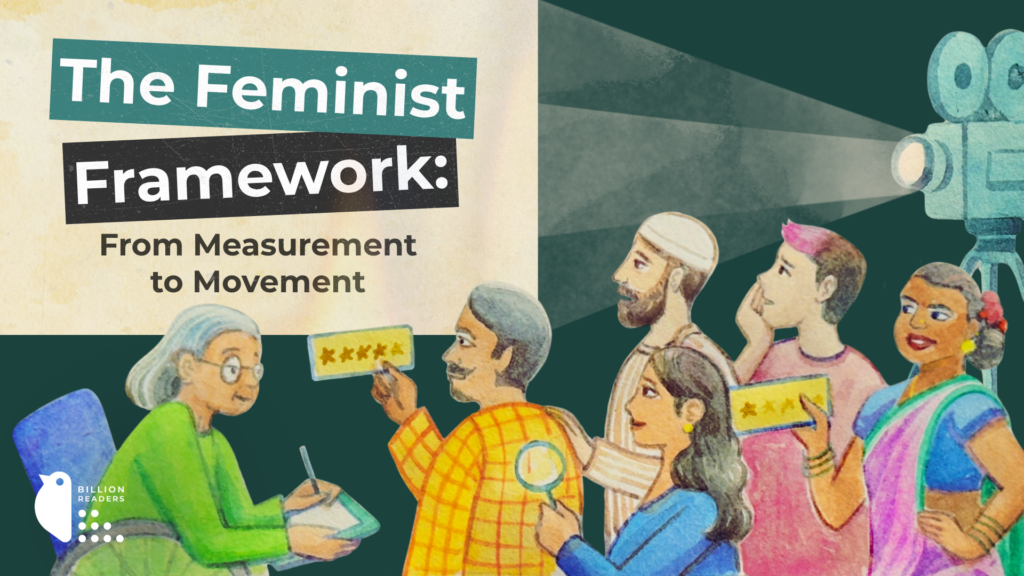
When we watch a film or a TV show, many of us instinctively sense if something feels off. Things like a woman being mocked for speaking up, a Dalit character shown only in a subservient role, or violence portrayed as entertainment. These moments signal how media shapes, mirrors, and often reinforces unequal social structures. But what if we could move beyond instinct and actually name and measure these patterns?
This question is what led us at BIRD to build the Feminist Framework.
The idea emerged when our team began receiving content from TV channels for Same Language Subtitling (SLS) in Punjab. Since we amplify these stories for large audiences, we wanted our choices to reflect our core values of dignity, inclusion, simplicity, co-creation, coalition, and evidence.
We often found media content that glorified regressive portrayals of women, children, or marginalized groups. The answer was clear: we needed a tool to evaluate whether a story reflected equality, equity, and empathy.
At its heart, the Feminist Framework isn’t about moral policing. It’s about generating awareness by looking at media through a feminist lens and asking:
By making these questions visible, the tool helps us filter which stories we can associate with, keeping in mind our values and vision.
Sexism and patriarchy are systemic structures, and the media, like any social institution, participates in maintaining these structures by normalising the hierarchies of gender, caste, class, religion, ability, and sexuality.
Popular media routinely portrays a world where women are rewarded for silence, compliance, and the performance of prescribed gender roles. Under the guise of “culture” or “sanskar”, it subtly outlines how women “should” behave, the limits placed on their rights, and what forms of violence or discrimination are seen as acceptable. Men, conversely, often face fewer consequences.
A feminist analytical framework becomes essential to examine how such content reproduces these hierarchies, shapes our imaginations, and influences real-world behaviour.
Taking inspiration from Breakthrough’s Media Communication Toolkit, the Feminist Framework is a way to evaluate films, TV shows, and other visual content on a simple scale from 1 to 10. It measures how “gender-progressive” or “gender-regressive” a story is based on six key parameters:
Every rating is supported by a short written justification so that the reasoning is transparent. This reflects our commitment to evidence, by using data and documentation to understand and improve what we do.
Media interpretation is inherently subjective but not in the sense that it is purely personal. Subjectivity is shaped by our social world: our gender roles, caste location, class position, cultural norms, and lived experiences. In simple terms, subjectivity is “who we are, how we see ourselves, and how we understand the world.”
Recognising this enriches the framework. It invites collaboration by encouraging viewers, especially women and marginalised communities to articulate how they perceive gender representation. Their interpretations become central to the analysis, turning the tool into a participatory space rather than a top-down assessment.
When we talk about gender, we also talk about the many identities and vulnerabilities that intersect with it.
The Feminist Framework holds these intersections at its center. It asks:
By addressing these intersections, the tool pushes us to see beyond numbers and understand which stories are being told, how they are told, and who gets left behind.
The first version of the tool, Feminist Framework 1.0, helped us flag harmful portrayals such as violence, objectification, and regressive stereotypes. It gave us a method to align our content choices with our mission.
But as we applied it, we realized that stories exist on a spectrum and cannot be reduced to “good” or “bad.” A film might begin with deeply regressive realities but end on an empowering note. Another might seem neutral but quietly reinforce inequality.
So we reworked the tool into Feminist Framework 2.0 to make it clearer, more nuanced, more flexible, and inclusive. This evolution embodies our value of simplicity: simple, clear tools can make complex analysis accessible to everyone.
When our operations team in Punjab tested it on the film Kali Jotta, they helped refine the tool to ensure it could be easily used by people with diverse educational and cultural backgrounds. This kind of co-creation was an important part of bringing this tool to life.
Today, the Feminist Framework is more than a rating system. It’s a feminist practice that reflects our values in action.
For researchers, it offers a structured, evidence-based approach to media analysis. For communities, it provides a way to articulate why something feels empowering or regressive. For creators of content, it invites reflection on the messages their work carries.
Our vision is that the tool becomes a shared resource, allowing women and audiences everywhere to engage critically with the stories they watch and to own that process fully.
Because the stories we consume shape the world we imagine. And when we create and evaluate them together with dignity and simplicity, we move from measurement to movement.

Researcher – Gender & Media – Anushree joined PlanetRead as a Researcher: Gender and Media. With an MA in Development from Azim Premji University, she started her career with a grassroots development organisation called Gram Vikas in Odisha. Transitioning to gender research, Anushree also conducted an impact evaluation study of the SWAYAM project under NRLM in Deogarh, Odisha, using ethnography and qualitative methods.
She plans to use her research experience to contribute more to policymaking and on-ground implementation efforts by PlanetRead in order to advance literacy and accessibility. She also has a keen interest in photography and is eager to explore how it can be used as a medium in her research.




Leave a Reply